A One Mann’s Movies review of “The Testament of Ann Lee” (From the 2025 London Film Festival). (2025, 3*, 15).
“The Testament of Ann Lee” is out in UK cinemas today. So I am reposting my review of the film from the London Film Festival.
This review was first published on October 12th 2025.
=======
Was I the only one who didn’t know that the Quaker movement called the Shakers, that is the subject of this film, was so called because of their strange movements during worship (or, as it seemed to me, some sort of exorcism of bad deeds)? Regardless, “The Testament of Ann Lee” is a slightly odd film charting the path of the Manchester-based organisation and its transfer to America.
This is written by the married couple of Brady Corbet and Mona Fastvold, the same writing team behind “The Brutalist“, which of course was directed by Corbet. As such, this was a very hot ticket at the press screenings, and I only managed to get in to see it through a wait list.
But – part drama, part quasi-musical – I wasn’t sure afterwards whether I liked this one or not. It’s a curious beast.
One Mann’s Movies Rating:

Plot:
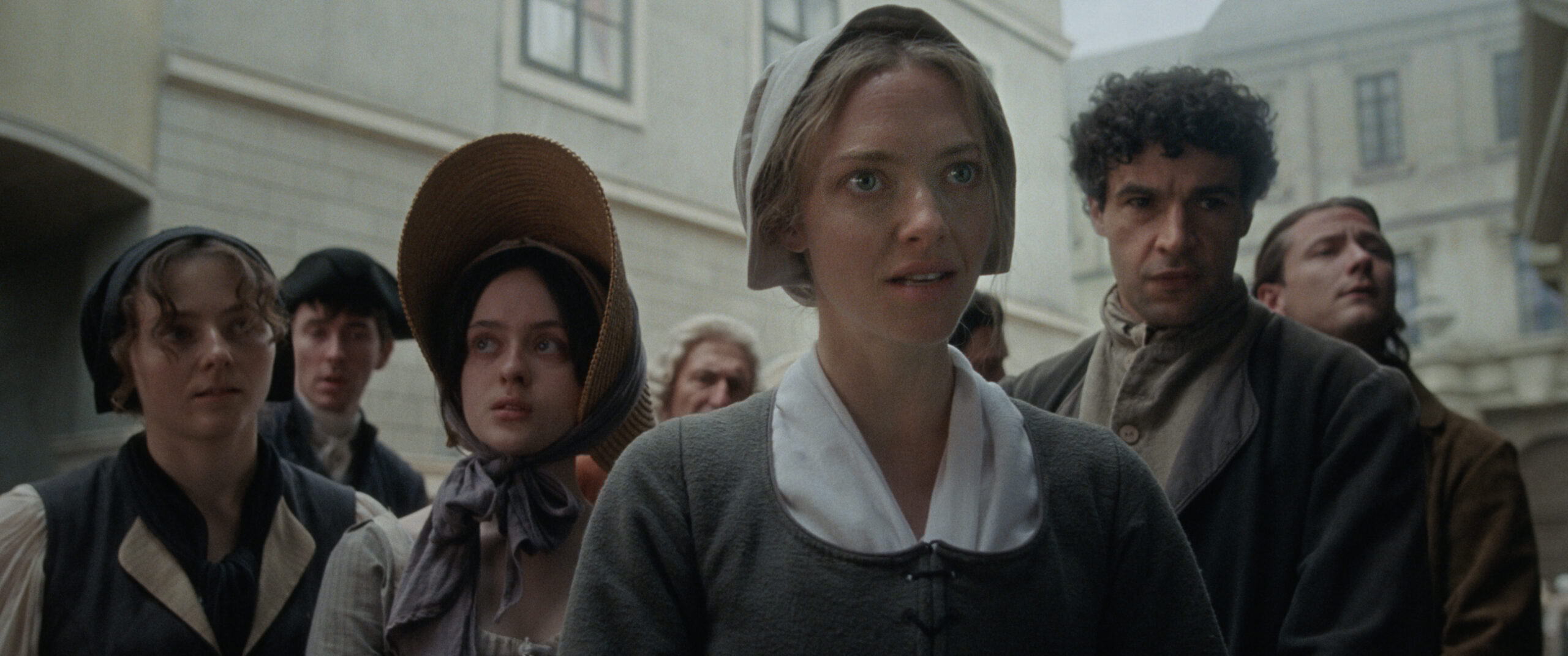
It’s Manchester, 1736. Ann Lee (Esmee Hewett) is a young girl subject to a strict upbringing who keeps having heavenly visions. Wind forwards 10 years and Ann (Amanda Seyfried) is a cook at the local infirmary. Together with her brother William (Lewis Pullman), they attend The Wardley Society run by Jane and James Wardley (Stacy Martin and Scott Handy) where Ann gets increasingly fervent about the cause.
Certification:
UK: 15; US: R. (From the BBFC web site: Strong sex, abusive behaviour, violence, injury detail, distressing scenes.)
Talent:
Starring: Amanda Seyfried, Lewis Pullman, Thomasin McKenzie, Christopher Abbott, Stacy Martin, Tim Blake Nelson, Jeremy Wheeler, Daniel Blumberg, Scott Handy, Esmee Hewett.
Directed by: Mona Fastvold.
Written by: Brady Corbet & Mona Fastvold.
Running Time: 2h 17m.
Summary:
Positives:
- The choreographed chanting and movements are strangely engaging.
- The film readily explores just how shit life was for women in the 18th century.
- The film provides some memorable scenes, given the limited budget.
Negatives:
- The songs never feel like musical numbers: more like the saying of psalms.
- Some of the action against the women will be too brutal for some sensitive viewers.

Full Review of “The Testament of Ann Lee”:
A strange form of musical.
The IMDB description for this one is Biography-Drama-History-Musical and, yes, it is all of those things but in terms of “Musical”, only to a degree. If you are expecting the 1800’s version of “La La Land“, you are going to be severely disappointed.
The dancing is more a choreographed sequence of the sort of hand shaking and body convulsions that you see the Shakers perform as they are ‘confessing’ the sins of someone in the community: for example, a guy who has been having incestuous and sinful thoughts about his young sister. These scenes are dynamic and strangely engaging.
And there are ‘songs’, but they are often more like chanted hymns. Some, like the “I Never” song and the “Hunger and Thirst” song, are more recognisable as ‘numbers’: I wonder if either of those might creep their way onto the Oscar “Best Song” nominations list?
In general, the music by Daniel Blumberg is eerie and disturbing, for example in the troubling infirmary scenes.
A woman’s life.
It really was a very poor life for a woman like Ann in the mid-1800s. Ann is married to Abraham (Christopher Abbott) but his idea of sex is to thrash Ann first and then make it a very one-way transaction. This is yet another set of scenes to add to the “Bad Sex” chapter of my as yet unwritten book on Sex at the Movies. And, very sadly, Ann was not even to ‘benefit’ from the sex, since she lost all of the four children that were born to her before the age of one.
We also see how tough the prison system was for Ann. A memorable scene is to see families visiting the prison walls to put food into baskets to raise up to their loved ones inside.
A religion I knew nothing about.
Where the film was good was in shining a light on an historical figure I knew nothing about and a religion I was also unaware of. The Shakers believed that because man was formed in his likeness then God must be both male and female. And further, after her intense visions when near death, that Ann herself is the second coming: the “wife” of Jesus Christ. I’m sure this will be seen as offensive to many Right-Wing Christians, but the film is only stating what, historically, was believed.
Sadly, the end titles describe how the religion has declined since the 1880’s from some 8000 believers to just 2 in 2023… a very precise number! They should have just named them! I guess given that fornication, even between man and wife, was rejected as a part of the religion then this was never a religion that was likely to grow at the same rate as Catholisism where, in the immortal words of Monty Python, “Every sperm is sacred”!
And so to America.
The production values of home life in Manchester are good, but the budget really gets spent when the Shakers set sail for America. We have some dramatic seabound scenes on a rickety old ship and when we get to the States there are good production values for a fledgling New York. We see Slaves being sold with Ann and the other Shakers shouting “Shame, shame, shame!” at the owners. You can tell that these are not people who are going to make friends.
These scenes of early settlement are well done and the special effects of some of the backgrounds reflect the film’s budget (like “The Brutalist“, only about $10 million). But a total eclipse (which history shows happened in Massachusetts on October 27th, 1780) is impressively visualised.
Good performances.
Amanda Seyfried delivers another strong performance and Lewis Pullman is also good. But I managed to get through the whole film without realising that Mary – who narrates the film – was actually one of my favourite actresses, Thomasin McKenzie.
Triggers
Note that the scenes in the first half of the film, where Ann both gives birth to four children and then loses all of them – sometimes through stillbirth and sometimes later through illness – are quite traumatic and will likely be triggering for any viewers who have similarly been in that tragic situation.
Summary Thoughts:
I feel like I may have been a little harsh with this rating, since I should be valuing how different this movie is… and it is well-delivered. But overall it didn’t really fully click with me and it would not be one I would be hurrying to rewatch.
Where to watch?

Trailer:
The trailer is here: https://www.youtube.com/watch?v=Rb0ZhiDD9J0.
Subscribe
Don’t forget, you can subscribe to One Mann’s Movies to receive future reviews by email right here. No salesman will call!